27 April 2020

Leonas and Konstancija

Here is the 1917 marriage record of Leon and Constance Palas (Leonas and Konstancija Polivlauskas), the mother and father of Mildred and Helen.

Marriage of Leonas Povilauskas and Konstancija Matulis
March 6, 1917

I searched for it mainly to confirm that Konstancija is indeed the sister of my great-grandfather, along with Anna. She is. Her parents are listed as Mikolas Matolis and Kotrina Miloszis, which are a couple of the spelling variants I've seen. Miloszis would be written as "Milošis" in Lithuanian, and this a shortened variant of the longer Milaševičius I've seen more frequently.

These spelling variations can seem quite haphazard, and even raise some doubts as to whether or not the records match up, but I'm careful to cross reference many records. These variations are the result of many external influences, such as Polish and Russian language influences, multiple alphabets, strong accents, and even sometimes low literacy. The -evič bit in the middle of Milaševičius, for example, comes from the Polish influence and many of the other spelling variations are a result of the name being recorded in multiple charcter sets over generations. The (imposition of!) the Russian cyrillic alphabet, for example, introduced many corruptions of names within families - my name Matulis, for example, has appeared as Matolis, Matuolis, Matolisov, and others within my own family.

At the time the marriage record above was produced, 1917, Lithuania was still under the control of the Tsar, hence why the document says they're Russian. I always feel compelled to say, they were NOT RUSSIAN!! You can only say they were insofar as Lithuania was momentarily occupied by the Russian Empire.

This document also tells me the parents of Leonas. I have been trying to figure out the circumstances of Anna and Konstancija's arrival in the United States. Anna appears to have emigrated as an unmarried woman in 1909, and the unmarried Konstancija joined her in 1915. I suspect that their husbands may have come from the same village, but will only be able to confirm this if I can find records of their husbands (Joseph and Leonas) in Pociuneliai, where Anna and Konstancija (and the rest of the Matulis family) comes from. The names of their parents Jurgis Sviatikis / Agnieszka Stakauskyte and Augustinas Povilauskas / Magdalena Antanaite, notwithstanding spelling corruptions, might help as I search the Lithuanian records.

25 April 2020

Unknown Wife of Mildred's Son

Scrolling back through some of my earlier posts, I discovered a couple of comments on a post about Konstancija Matulyte. They were posted months ago, back in the beginning of January, but for some reason, the system never notified me!


It's a shame that I wasn't notified, because I'd very much like to share information. The person commenting identifies herself as the wife of Mildred's son. Sadly, she only appears as "Unknown" in the comment box, so I have no way to get back in contact (without some serious genealogical sleuthing!).

The Mildred she refers to was Konstancija's younger daughter, which means her husband is my "second cousin, once removed". The other information in her comment is interesting in itself:
Lidmilla Auelija Pavilauskas was born 14 April 1921 in Manchester NH.
Mother Kostance Matutiuke Pavilauskas, age 28
Father Leonas Pavilauskas, age 31.
I'm not sure where that information comes from, but it matches the information I know (bar a few spelling peculiarities). I suspect that the real spelling is Liudmila Aurelija Povilauskas, based on my knowledge of Lithuanian names. But it is helpful to know the "Mildred" was actually "Liudmila". The other main thing is Konstancija's maiden name, "Matutiuke", is a corruption of Matulyte (the female version of my own name, Matulis). I've seen mispellings like this all over the place, including Mildred's sister's marriage record, where it appears as "Matulinkie". On that same record, the unmarried "Mildred Palas" appears as a witness, and signs in her own hand (and the address she includes, 109-48 118th Street, Queens, NY, still exists today!).

Mildred's married name was apparently Crabtree, according to her sister's obituary. So with some effort, I might be able to track down the person who posted these comments.

There's a lot I'd like to know about this distant branch of the family, particularly how Konstancija and her older sister Anna arrived in the United States. What brought them here? Was there other family? These are questions I'll continue to explore through genealogical records myself, but sometimes there can be clues buried in living memory, family photos, or old letters.

So please contact me, Unknown Wife of Mildred's Son! I can offer quite a lot of information about your family's Lithuanian ancestry. I'm fairly easy to find if you google me.

16 April 2020

Six Generations

I can now trace my Matulis lineage back 6 generations, including myself.

I was able to do this using a small clue on my great-great-grandfather Mykolas Matulis's death record. The record gives Mykolas's name as Михаил Кароловъ Матулисъ. His middle name "Karolov", is actually a patronymic - it is formed of his father's first name. My 3x-great-grandfather was Karolis Matulis! That's six generations.

With some searching, I was able to find Karolis's death record. He lived to 88 and died just six months before Mykolas, who died at just 55.

Karolis Matulis
(death 1917, age 88)

Column 1: Тысяча девятьсотъ семнадцатого дня ? года Іюля двадцать девятаго дня въ Жагуняхъ скончался Кароль Матолисъ отъ старости. Пріоб. Св. Таинъ. / One thousand nine hundred and seventeenth year, on the twenty-ninth day of July. Karol Matolis died in Жагуняхъ from old age. There was a communion of holy sacrament.
Column 2: Крестьянинъ Кракиновской волости имевшій отъ роду 88 лѣтъ оставилъ жену изъ Петкевичей, детей Іоанна, Михаила, Константина, Іосифа и Кароля, здешний прихожанин. / The peasant of Krekenava district, 88 years old, [died and] left his wife, of Petkevičai [family], and children Jonas, Mikhail, Konstantin, Josif, and Karolya. Parishioner here.
Column 3: Тѣло его по истеченію сутокъ на Пацунельском кладбище похоронилъ Кс. А. Купчисъ. / Ks. A. Kupčis buried his body after a day in Pociunelai cemetery.

The record provides lots of information to start building the family tree beyond my direct lineage. First, his wife, my 3x-great-grandmother, had the maiden name Petkevičiute. It doesn't give her first name, but I will still probably be able to locate her in the records. Karolis's children were Іоанн (probably Jonas), Михаил (Mykolas of course), Константин (Konstantinas), Іосиф ("Josif" or probably Juozas), and Кароля (Karolya).

Partial Matulis Family Tree

The tree above is partial. It leaves off most of the descendants beyond my direct lineage (Karolis >> Mykolas >> Silvestras >> Vacys >> John >> me), including those stemming from my grandfather's generation that I already know and have contact with.

Sadly, the record of Karolis's death doesn't give his patronymic, or else I'd be well on my way to identifying the seventh generation. Instead, I will need to search for Karolis's birth record, way back in 1829. Those records, however, are in Polish! They're in Polish because hiss birth preceeded the first rebellion against the Tsar in 1831, the November Uprising. He was just two years old when that happened. It seems my ancestors have a habit of being born into tumultuos times.

A Connection to History

When I found my great-grandfather Silvestras's birth record this past November, I was able to confirm the names of my 2x-great-grandparents: Mykolas Matulis and Katerina Milaševičiute.

I searched for the death records of Mykolas and Katerina at the time too, but came up empty handed. The search was slowing-going and laborious, given that the records were mostly un-indexed. Adding to the problem was that I assumed they'd lived much longer than they actually had, so I had started my search in the wrong date range. When I recently found the records, I learned that Katerina only lived to 47, and Mykolas 55. That means my great-grandfather Silvestras lost his mother when he was just 16 and father when he was 22!

Katerina Milaševičiute / Matuliene
(death 1912, age 47)

Column 1: Тысяча девятъсотъ восемнадцатого года Января двадцать девятаго дня въ Жагуняхъ скончался отъ рака Михаил Кароловъ Матулисъ. Пріоб. Св. Таинств (?)
Column 2: Крестьянинъ ______ волости Пацунельский прихожанинъ пятидесяти пяти лѣтъ оставилъ жену ________ урод (?) Ласианскую, сына Сильвестра и дочерей Анну, Констанцію, Яльзбету, Антонину.
Column 3: Тѣло въ узаконенное время похоронилъ на Пацунельскомъ кладбище Кс. _____ Купчина

Mykolas Matulis
(death 1918, age 55)

Column 1: Тысяча девятьсотъ двънадцатого года Января двадцать девятаго дня въ Жагуняхъ скончалась Катарина изъ Милашевичей Матолисъ отъ болезъни мизерере Пріобщена Св. Таинъ.
Column 2: Крестьянка Кракиновской волости оставшегося вдовцом Михаила Матолиса жена 47 лѣтъ Пацунельская прихожанка оставила сына Сильвестра и дочерей: Анну, Констанцію, Ельжбѣту и Антонину (?).
Column 3: Тѣло ся сего года Января 31 дня Кс. А. Купчисъ на Пацунельском кладбище похоронилъ.

Key bits of information here include the names of their other children (Silvestras's siblings) which really helps me to link up the various Matulis records I've been collecting from the parish registers. The children include Silvestras (Сильвестр my great-grandfather of course), Ona (Аннa), Konstancija (Констанцію), Elžbeta (spelled variously as Ельжбѣту and Яльзбету), and Antonina (Антонинa). I didn't know about those last two! There could be others too, as I believe the records only list surviving children -- any that may have predeceased their parents won't appear.

Counting back from his age at death, Mykolas would have been born around 1863, which is the very same year as the ill-fated January Uprising. The Tsar's response to the rebellion was harsh. After mass executions and deportations to Siberia, he implemented strict "Russification" policies aimed at supressing Lithuanian (and Polish) identity and culture. He banned the Lithuanian press, outlawed the Lithuanian alphabet, ended education in the Lithuanian language, and imposed a new administrative region called "Northwestern Krai". This attempt to "Russify" Lithuania, however, ultimately failed. In fact I've always believed that this suppression of culture is precisely why Lithuanians (myself included!) are so emphatic about the preservation of Lithuanian identity. (The more recent Soviet attempt at similar Russification only made resistance more resolute).

It was during the post-Uprising repression that the famed Lithuanian knygnešiai (book smugglers) risked their lives to carry Lithuanian literature and educational material across the border from Prussian Konigsberg. It was, in large part, thanks to them and underground homeschooling that Lithuanian identity was preserved during those difficult years. My great-great-grandfather Mykolas and great-great-grandmother Katerina would have grown up right in the middle of it! Notably, Mykolas died in 1918, just a couple weeks before the Act of Independence and the restoration of Lithuanian statehood. Oh, the changes they must have seen in their lifetimes!

One of my main motivations behind all this genealogy is that it helps to make my interest in history so much more real and relatable. When I'm able to imagine these events through the eyes of my own ancestors - through the eyes of people who bear my own name! - it just makes it all the more vivid.

08 November 2019

Peasants of the Krekenava District

An interesting side note to these birth records I've been digging through, relates to the heading of one of the columns on the forms.


It reads: "To which parents and which estate or society [class?] do they belong, when and where, i.e. in which parish, was the baptised person born?"

To which estate does the person belong?! This appears to be a reference to the system of feudalism that the Russian Empire imposed on its territories. When the Russians took over in the late 1700s, they formalised a strict set of social rules and hierarchies. Common people were made into serfs who had few rights, including no freedom of movement. The practice formally ended in 1861 when Tsar Alexander II made the "Emancipation Edict". He was no progressive visionary though. In breaking the news to the nobility, Alexander gave his reasoning:  "It is better to abolish serfdom from above, than to wait for that time when it starts to abolish itself from below." Even after this edict, though, most serfs continued a meager existence.

The birth records I've been looking at were made some 35 years after the serfs were emancipated. It just seems nobody bothered updating the forms. Regardless, they still make a person's place in society clear. My ancestors are identified as крестьянь Кракиновской волости, "peasants of the Krekenava district".

Namesake

In addition to Anna's baptism record, I also managed to find my great-grandfather Silvestras's and send it off for transcription. In the meantime I've become quite good at discerning "Матулисов" in the handwritten documents, so I'm working my through a heap of them in an attempt to build out the tree more fully.

Literally, "Matulisov", a Russified version of my name.
(One of the more notable peculiarities of handwritten Russian
is that what looks like a lower case 'm', is actually a т!)

Silvestras Matulis, born 27 January 1896

Here's the transcription and my best attempt at translation:


B
i
r
t
h
d
a
y
B
a
p
t
i
s
m

d
a
y
When, where, who and by whom, whether with water or with all rites of the sacrament christened? To which parents and which estate or society [class?] do they belong, when and where, i.e. in which parish, was the baptized person born? Who were the godparents at holy baptism, and who was present?
T
r
a
n
s
c
r
i
p
t
i
o
n
11 27 29 Тысяча восемьсот девяносто шестого года января двадцатьдевятаго дней, вь Пацунельскиь Р. Кот. филіяльномъ костель Кс: И. Мартин_ус_ окрещено дите именемъ: Сильвестрь, совечми обреядами таинства. крестьянь кракиновской волости Михаила и Екатерины изъ Милашевачевь Матулисовь законногов супруговь сынь родившийся 1896 года 27 января вь Кургула_ Кракиновск__ прихода. Восприемниками были:
Сильвестрь Милашевичь,
Барбара Милашевичов__
T
r
a
n
s
l
a
t
i
o
n
11 27 29 One thousand eight hundred and ninety sixth year, twenty-ninth day of January, in Pociuneliai R. Cat. filial church [??]: I. Martin?us? baptised a child named: Sylvester, with all rites of the sacrament. Peasants of the Krekenava district Mikhial and Ekaterin of Milashevachev Matulisov [Mykolas Matulis and Katarina Milaševičiute], legal spouses, son born 27th January, 1896 in Kurgulai, Krekenava parish. Witnesses were:
Sylvester Milashevich,
Barbara Milashevichov[??]

I initially searched through the records for 1895 looking for this document because that's the date that is on Silvestras's gravestone. But it turns out that he was actually born in 1896 and his gravestone is wrong!

Photo taken in 2013.
Shows incorrect birth year for Silvestras.

The spelling variants are getting a little crazy now. Of course the endings of names change in Lithuanian, but now with the Cyrillic character set and the Russian endings and conventions, it's getting downright disorderly. On this document, my 2x-great-grandparents are listed as Mikhail and Ekaterin, but on Anna's document, they are Mikhail and Katerina. On one they appear as "Matulisov", and on the other it's "Matolisov". Sometime Katerina's maiden name is "Milashevich" and sometimes "Milashevichov__" (with an extended ending that I can't quite make out). There are too many commonalities between the documents (and the village is much too small) for these to be just two very similarly named families, so I'm sure that's not the issue though. Besides, everything is corroborated by things my great-uncles in Lithuania have told me -- for example, that some of our relatives use "Matuolis" to this day.

The thing struck me the most on this document was the name of Silvestras's godfather: Сильвестрь Милашевичь. Sylvester Milashevich!! Or, in Lithuanian, probably Silvestras Milaševičius. The name I share with my great-grandfather (Brett Sylvester Matulis), goes back even further than I thought. I'm not sure yet if Silvestras Milaševičius is Katerina's father, or maybe her brother, but I immediately felt a connection to him. The "Sylvester" name is really extensive in my family. In addition to Silvestras Milaševičius, there is Silvestras Matulis (my great-grandfather), Silvestras Kemešys (my great-grandmother's brother), and Sylvester Žukauskas (my grandfather's first-cousin). All that in addition to it being my, my dad's, and my brother's middle name. I will definitely be searching for records of the Silvestras and Barbara listed as godparents here.

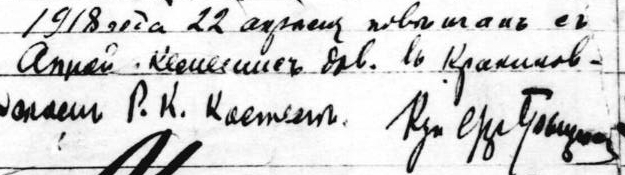
Besides what's transcribed about, there's an additional note in the margin, dated 22nd of April 1918. It's very hard to read but apparently relates to his marriage to "Anna Kemeš___". Of course that's Ona Kemešyte!, who I know he married in Krekenava. Perhaps the Pociuneliai priest just noted it here in the margin of the Pociuneliai book because the wedding took place at a different church. There's a second note dated 1965 (five years after his death, according to his gravestone), but it's just letters and numbers, so I don't know what it refers to.

Written in the margin.

Second note

05 November 2019

Squiggles on a Page

The exciting find of the birth record for Anna, my great-grandfather's older sister, was frustrated by my inability to read handwritten Russian script -- "squiggles on a page", I called it. A Russian speaking friend helped a little, but also struggled. So I sent the document off to an online Russian transcription service (and crossed my fingers that I hadn't just volunteered my credit card for fraud). The result came back, and I'm happy to say, so far so good.

Here's what I found out:

Р
о
ж
д
е
н
и
я
К
р
е
щ
е
н
и
я
Когда, где, кто и кемъ, одною - ли водою или со всеми обрядами таинства окрещенъ? Какихъ родителей и къ какому сословию или обществу они принадлежатъ, когда и где, т.е. въ какомъ приходе родился крещаемьй? Кто были по имени прозванию восприемниками при св. крещении и кто присутствовалъ?
T
r
a
n
s
c
r
i
p
t
i
o
n
17 18 19 Тысяча восемьсотъ девяносто первого года января девятнадцатого дня. Въ Посцунель???ъ Р.К. филіяльномъ костёле [??]: И. Мартыи[усол??]ъ окрещено дитя именемъ: Анна, съ всъими обрядами таинства. Крестьянъ Кракиновской волости Михаила и Катержины изъ Милашевичевъ Матолисовъ, законныхъ супруговъ дочъ, родившаяся 1901 года 18 января въ Жиборт[???]ъ Кракиновского прихода. Воспріемниками были: Константинъ Матолисъ Елеонорою Милашевичевою.

And this is my attempt at translating (with heavy reliance on Google and input from friends):


B
i
r
t
h
d
a
y
B
a
p
t
i
s
m

d
a
y
When, where, who and by whom, whether with water or with all rites of the sacrament christened? To which parents and which estate or society [class?] do they belong, when and where, i.e. in which parish, was the baptized person born? Who were the godparents at holy baptism, and who was present?
T
r
a
n
s
l
a
t
i
o
n
17 18 19 One thousand eight hundred and ninety-first year January, nineteenth day. In Pociuneliai R.C. church of [??]: I. Marti[usol??] baptised the child: Anna, with all the rites of the sacrament. Peasants of Krekenava district Mikhail and Katerina of Milashevichev Matolisov [i.e. Mykolas Matolis and Katerina Milaševičiute], lawful spouses, born 1901 year, 18 January in Žibartoniai of the Krekenava district. Witnesses were: Konstantin Matolis, Yeleonora [Elenora] Milashevicheva.

Most of the information is what I already knew, but the right hand column is significant. It says who the godparents were. It's not something I've seen on a birth record before -- actually this is a record of baptism, so it makes sense -- but it could really help me to build the family tree. Since it is common for aunts and uncles to be godparents, it could provide me with some hints beyond the direct lineage of parents. Of course people who are completely unrelated can also be godparents, so I'll need to verify everything with other records.

The document also says Anna was born in Žibartoniai, which is the first I have seen that the family was there. It's very close to Kurgulai, where the family later lived and where my grandfather was born.

18 October 2019

Анна Матолисовa

When I came across Lithuania's "eHeritage" website in 2014, I described it as a potential goldmine of family history information. I did discover some information about Antonina Kemešienė, but I initially under-estimated just how hard it was going to be to read the handwritten Russian script that many of the documents are written in. The minuscule bits I was able to decipher gave me hope that there's some really useful information there, but even the native Russian speakers I showed had a hard time reading these documents. Not only is the handwritten Cyrillic script hard to read, it's apparently a form of "Old Russian" that isn't spoken these days. Needless to say, I didn't get far digging into these records.

Recently, though, it occurred to me that the birth of Anna Sviatikiene would likely appear in these records. Her death record (from 1972 in New Hampshire, USA) listed her birth date as 18 January 1891, so I pulled up the ePaveldas site and found this in the 1891 index of the Births book:


I wasn't all that confident I was deciphering it correctly, but I suspected the first two words might say Маmолuсовa Анна, or "Matolusova Anna". I flipped to the page where record #17 was listed ...and quickly gave up any hope of being able to read it myself!

May as well be squiggles on a page for all I was able to get from it.

I asked a Russian friend if she was able read it though. With some difficulty, she was able to tell me a few key things that confirm this is, in fact, Anna's birth record. First, it lists the names Милашевичев and Матолисов -- in Latin characters, that's Milashevichev and Matolisov. These are the surnames of Anna's mother and father (it says she's "the legitimate daughter of the peasants Mikhail and Katarina").

"Matolisov" is a Russified version of Matulis, and "Milashevichev" is a close approximation of the (likely corrupted) version I have seen elsewhere, "Milasziawicziuke". The correct Lithuanian is possibly Milaševičiute / Milaševičius.

From Anna's marriage to Joseph Sviatikis in 1912, New Hampshire
(NB: "Russia" is actually Tsarist occupied Lithuania!!)

The other piece of information confirming its the right document is the location. The document is in the Catholic register from Pociuneliai parish church. That's the family church (I learned during my first visit to Lithuania) where many of our ancestors are buried. The record indicates that Anna was born in the "Krakenovsk" region - that's Krekenava - in the county just next to Pociuneliai. The family lived in the village of Kurgulai in the Krekenava district, but they were closer to Pociuneliai than the town of Krekenava itself, so that's why they appear in the Pociuneliai books. (That's not to say, of course, that some of the documents won't be found in the Krekenava books, though, so I'll need to search there in the future too!!).

Like I said before, these books are likely a massive source of family history information. They really need to be dug into, the Russian script notwithstanding.

Just one final note to conclude. The reason these documents are written in Russian is because, until 1918, Lithuania was under Russian Imperial rule and the Lithuanian language was forbidden in an attempt to "Russify" the population.

It didn't work.

14 August 2019

Povilauskas / Hebenstreit

Last week I found Helen Povilauskas in the New York City marriage record index. I just happened to be in NY over the weekend, so I stopped in to the Municipal Archive to search their microfilm records. Since I had the index number, it only took a few minutes.

They keep a copy of the affidavit, the license, and the certificate -- which mostly all have the same information on them. The records didn't show me anything I didn't know already, since I had already identified Helen's parents on the census. I was hoping the marriage record might have their actual names, but unfortunately it still only listed the Anglicized forms - "Constance" and "Leo" - as well as a corrupted version of her mother's maiden name, "Matulinkie". Anyway, it was interesting to see signatures written in their own hands, including Helen's younger sister, who signed as Mildred "Palas".

Affidavit

License

Certificate

13 August 2019

NYC Homes

One interesting bit of information is that every building in the five boroughs of New York City was photographed between 1939 and 1940 for property tax assessment purposes. These photos are held in the NYC Municipal Archive and were recently digitized.

Since I noticed that the Povilauskas family was living in Queens on the 1940 census, I decided to have a look. What I found looks pretty similar to what's still there on Google Streetview.


They lived at 109-48 118th Street in Queens
("Block 11598", "Lot 30")
http://nycma.lunaimaging.com/luna/servlet/s/v9unk2

10 August 2019

Konstancija Matulyte?

The goal of digging into records of Helen Palas was to see if I could identify Helen’s mother, the third sibiling of Silvestras and Anna. Helen's death record gave me that information - at least the first bit of it. The parents were "Leon" and "Constance". My guess is that Constance's name was probably actually Konstancija. I have no idea what name would Anglicize to "Leon". (On a related note "Anna" Matulyte / Sviatikiene should actually be "Ona").

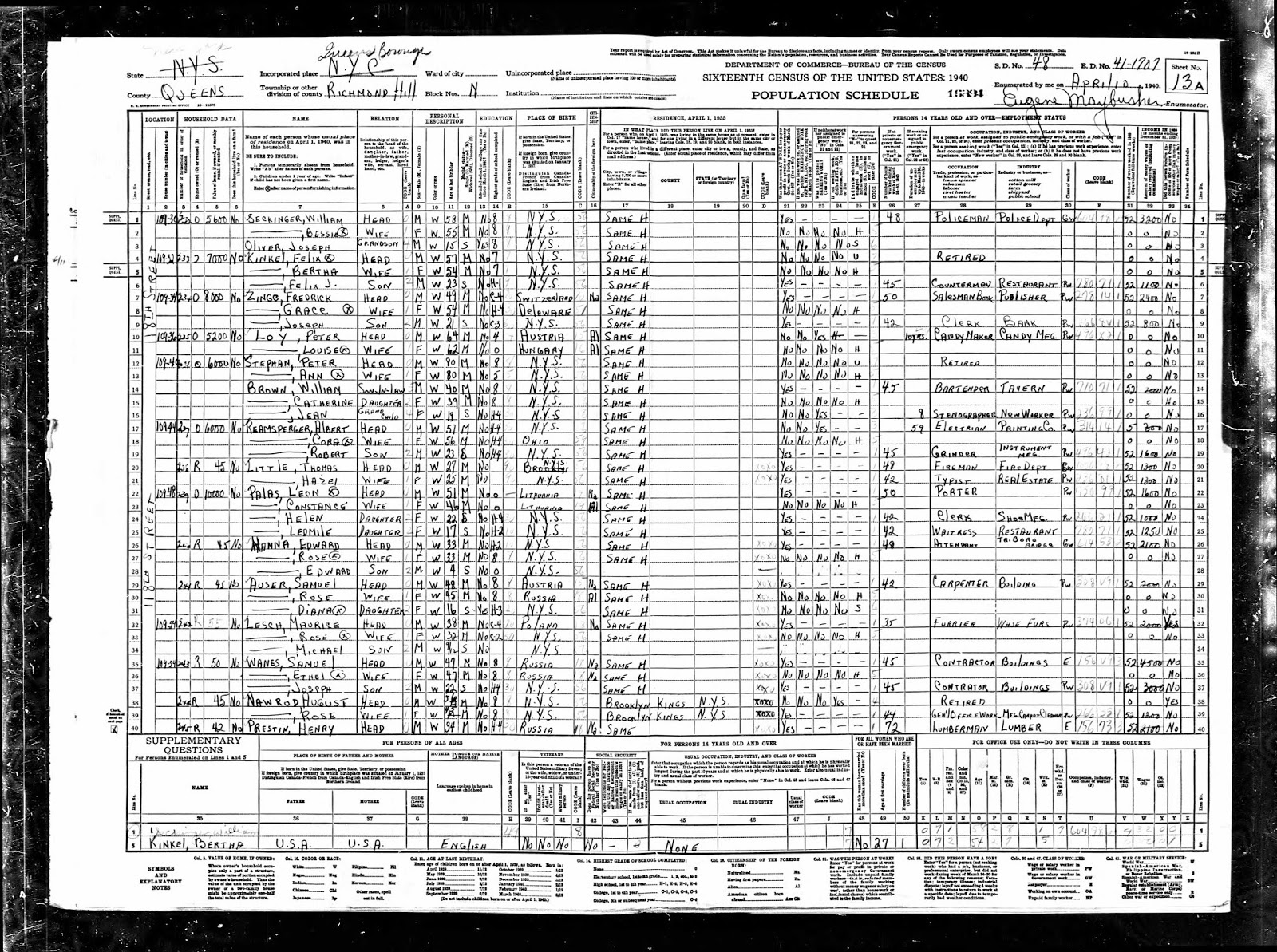
Knowing that the family used the name "Palas" rather than the actual Povilauskas, made it easier to find them in the census. So far I've found them in the 1930 and 1940 censuses.

Povilauskas / "Palis" family on 1930 census.

Povilauskas / "Palas" family on 1940 census.

In the 1930 census, they're using the name Palis, with an 'i'. But it's clearly them because both Helen and Mildred are with them. Further to that "Leon" appears as "Louis" (name variation chaos!). The 1930 census also tells me some very interesting things. First, it tells me that Constance was born around 1894. That means she's younger than her sister Anna. Secondly, it gives Constance's immigration date as 1915 - a full 6 years after Anna. Those two bits of information counter the theory that the unmarried Anna might have come to the US with her older married sister. In fact it might have been the opposite! Anna's younger unmarried sister might have come to the US to live with her! This, of course, still leaves the mystery about Anna's arrival. Does it mean that there was other Matulis family in the US before her? Or might it mean that Anna was just ahead of her time and emigrated on her own?

The last two bits of information that the 1930 census tells me is that Constance married at the age of 23 (around 1917) and her first two children were born in New Hampshire (around 1918 and 1922). I should be able to use that information to find their birth certificates. And it should also help me find them on the 1920 census, which should have them in New Hampshire (not NYC, where they are on the 1930 and 1940 censuses).

The 1940 census doesn't tell me much that the 1930 didn't already, except that they had bought a house in Queens.

08 August 2019

Helen "Palas"

After my discovery of the Povilauskas / Hebenstreit marriage record last night, I decided to go back to the library this evening and have a look at the actual file. My hope was that this marriage certificate would identify Helen's parents. Helen's mother is the third sibling of Silvestras and Anna Sviatek. All I knew from my grandfather (Vacys) was that this sister had married somebody with the name Povilauskas -- he couldn't even remember her given name.

To my slight disappointment, the record turned out to be just an index. It doesn't have all the details of the record itself. There is a license number though, so it will eventually give get me to the record I'm looking for. In fact, I just happen to be going to New York City this weekend, so I should be able to get the record while I'm there.

Helen Povilauskas
NYC Marriage License #6987, 29 August 1940

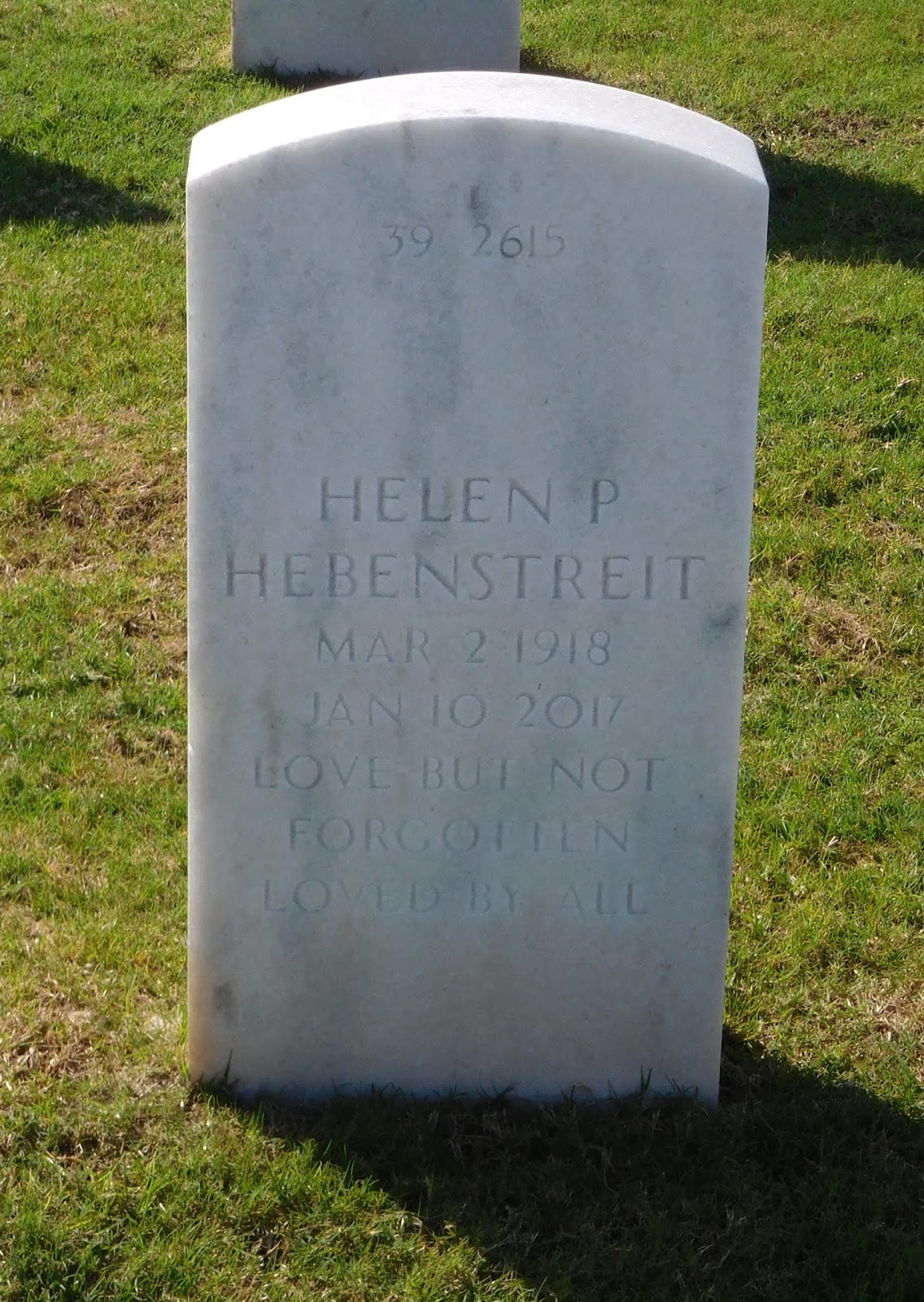
In addition to this record though, I was also able to find a grave image and obituary for Helen: https://www.findagrave.com/memorial/175691496/helen-hebenstreit. She only just recently died in 2017 at the age of 98! Here's what was written in her obituary:
Helen Palas Hebenstreit

Birth: 2 Mar 1918 New Hampshire, USA

Death: 10 Jan 2017 (aged 98)

Burial: South Florida National Cemetery, Lake Worth, Palm Beach County, Florida, USA

Memorial #: 175691496

Bio: Helen Hebenstreit, a North Palm Beach resident and former resident of North Caldwell, NJ, died January 10, 2017 at the age of 98. She was born March 2, 1918 in New Hampshire to the late Constance and Leon Palas. Helen was a past member of the Columbiette’s and volunteered at the Veteran’s Hospital in Florida. She loved children, flowers and animals. She is predeceased by her husband George, whom she was married to for over 70 years. She is survived by her children Debra Connors and her husband Timothy and Carolyn Hebenstreit. Also surviving are her grandchildren; Reece, Connor, Payton, Graham, Brennan, Timmy and Georgia. Helen is predeceased by her sister Mildred Crabtree. Interment Information - South Florida National Cemetery, 6501 S. State Road 7, Lake Worth, Florida.

Spouse: George A Hebenstreit 1917-2010
From www.findagrave.com

There's a lot of information there, and it should be helpful in finding more records. The main things that stand out are that Povilauskas was shortened to "Palas". Sara had actually told me yesterday that her aunt Jayne remembered them being called "Palace", phonetically the same. Knowing that they used "Palas" will definitely help me find them. The other thing is that her parents used the names Leon and Constance - that's them! Those are the two I'm looking for!! Constance is the sister of Anna and Silvestras. I'm quite sure those are both Anglicised - Leon and Constance aren't Lithuanian names - but "Leon and Constance Palas" might turn up on a census record. Finding those will be the next step.

07 August 2019

Anna Matulyte / Sviatekiene

** If you're confused about why I change up the endings of surnames, read this. **

Though I've not added anything to this blog in quite a long time, it's proven useful, on more than one occasion, for reconnecting with distant family links. Just recently, I was contacted by a couple third-cousins from the Sviatek family line who had come across something I'd written. Until now, I hadn't had any contact with the Sviatek (Sviatikis) group. Now hopefully I can fill in some details about that branch. Sara, one of the two who found me, was able to help fill in a mystery almost right away -- who's pictured in this photo:


The photo came from the album of my great-uncle Juozas Matulis in Pasvalys, Lithuania. He knew it was from the US, but he couldn't recall who was pictured. Phyllis Ouellet suspected it was "Annie" Sviatek, and she was correct. According to Sara, standing next to the car is her grandmother's mother, Anna. Anna is the blood relation between us. Our common ancestor was Anna's father, Mykolas Matulis. Anna's maiden name was Matulyte. She was the aunt of my grandfather (and possibly the person who sponsored my grandparents' emigration to the US!). Driving the car is Josephine Sviatek / Stillings. And an aunt (must be the daughter of Josephine) is in the back. Sara even knew where the photo was taken - Barrington, Rhode Island.

Sara sent me some photos of her branch of the tree.

Victoria and Ann
(daughters of Anna Matulyte / Sviatekiene)

Ann, Anna, and Albert
(daughter on the left, son on the right)

Anna, Josephine (holding son, Robert Stillings), and Joseph Sviatek

The Sviatikis Branch
Anna is the sister of my great-grandfather Silvestras.

I decided to send some back and dug up some scans. And I discovered some of the Sviateks among them!

Sviatikis and Matulis

After seeing Sara's photos, I recognised Joseph and Anna in this photo right away. They're with my grandparents (Vacys and Marija), my uncle Charlie / Gediminas, and my dad (John), but I didn't know who the other two were until now. Judging by my dad's age, it should be around 1950, just after they arrived (unless it's actually my dad and younger uncle Mike, in which case it's a few years later). The Sviateks have a funny habit of posing for photos in cars, but I guess owning a car was a big deal in those days.

Since making contact, I've become really curious about Anna Matulyte/Sviatikiene. When did she arrive in the US, why, and with whom? Anna and Joseph were part of the "first wave" of Lithuanian immigrants -- that is, immigrants who came during the tail end of Tsarist Empire primarily (I think) for economic opportunity as serfdom was ending in Russian territory (which included Lithuania). But as I posted before Anna married Joseph in the US in 1912, not in Lithuania before leaving. Does that mean she met Joseph in the US? It would have been unusual for an unmarried women to emigrate on her own in those days. Was that actually the case? If not, who did she emigrate with? So far as I know, her mother and father (Mykolas and Katrina) remained in Lithuania. What were the circumstances of her arrival?

I looked back at copies of the 1920 and 1930 census that I downloaded previously, and discovered something I hadn't noticed before. Both censuses say that Anna arrived in 1909 and Joseph arrived in 1910! She did, indeed, arrive first.

1920 Census showing dates of immigration

1930 Census showing dates of immigration

This is significant because it could mean there were other Matulis relatives in the US that I don't know about. Or possibly even more interesting for the period, she emigrated alone as an unmarried woman of 18 years age. Since she arrived in 1909, she should appear on the 1910 census.

I went to the library earlier this evening to use their Ancestry subscription and did my damnedest to find her using all the variations of her maiden name I could think of. No luck! New immigrants often don't respond to the census, so there's a chance she's just not there, which would be unfortunate.

Thinking back on what my grandfather once told me, his other aunt (Povilauskiene) might have emigrated too. Perhaps she was older, perhaps she was married, perhaps Anna emigrated with them. The key to tracking down Anna might be tracking down her sister.

I conveyed all this to Sara, and she got some really helpful information from her aunt. She had attended Anna's sister's funeral (probably in the late 1960s) in New Jersey. Anna's sister had been living with her daughter Helen (would have been Helen Povilauskaite) and Helen's husband George Hebenstreit (they might have had a daughter named Debbie). The combination of "Hebenstreit" and "Povilauskas" is a genealogist's dream -- you can be pretty sure you've got the right people when you find records that match.

A bit of searching and, bingo!


I can't access the record until I go back to the library, but I'm hoping this will help lead me not just to Anna, but also Anna's sister -- two more of the Matulis group, right here in the US. All this has revived some of the momentum to pick up this genealogy stuff again.

There's been several other things I've wanted to add to this blog over the last couple years too, but have really just neglected it. Maybe I'll try to post some other updates too.

26 April 2017

Old Apartments

I did, finally, get a couple hours to check on the old addresses of the Leitners and O'Neils while in NYC this week. I went for a run around Central Park from our Midtown East hotel and stopped along the way at the addresses I had found at the library. I went around counter-clockwise, so I stopped at 2 West 104th Street (the O'Neils residence) first.


It was right on the corner of 104th and Central Park West - a really incredible location! - but I quickly discovered that the area had been through some difficult times. Many of the lots on the block had been demolished! Building #2, where the O'Neils lived, was no longer there. There were a few (quite nice) community gardens along the way, in place of the old vacant lots.

Community garden just beyond 4 West 104th Street.

I knew immediately what this meant. We had just been through a gentrification tour in Lower Manhattan with our students and had stopped at a community garden to explain how they'd been established through a long process of decline, dereliction, and regeneration. Slum lords in New York would do little upkeep on their buildings and eventually they'd become uninhabitable. Many were condemned and demolished. A lot of the properties were abandoned by their landlords, and the lots were squatted on. Then things went in one of two ways: a new wave of investment redeveloped (usually high rent) apartment buildings, driving up rents and driving out working class residents (who had been using the lots as gardens); or ownership couldn't be resolved and the city (reluctantly) took control of the gardens and offered arrangements for community management (ironically this often made the surrounding areas quite appealing to the middle-class, which drove up rents, and drove out all but those few who have been able to hold on to rent controlled properties).

The building on the left is where I believe #2 stood. The second
building is currently #4. And the space to the right of that is one
 of the community gardens.


When I arrived at West 104th Street, there was an elderly lady gardening in one of the lots up the street, so I asked what history she knew of the area. She said it was in the 60s or 80s that many of the buildings had been demolished. I actually have vague recollection of Dampa telling me that he had visited there with Nama (in the 90s?) only find her home had been demolished. But maybe that's just a false memory affirming what I now know to be true.

Later on I went back to the library to find out what I might be able to learn about the properties that used to be there. There are some great resources that I will need to dig into, one of which is an archive of photographs of every NYC lot from 1939. It was apparently a Public Works project after the depression, but a great resource for today! It should have an image of their building, since I know they were there in the 40s. The records are kept at the Municipal Archives (31 Chambers Street).

Another resource is the NY Public Library Map Warper, which has historical maps online, so I can see how things changed over time and, perhaps, find out when the building was demolished. The librarian showed me one map that showed building #2 stood on block 1839, lot 36. A contemporary map shows something different, so the change will likely date back to the demolition. He also said the Municipal Archives should have records like Notices to Build and New Building Applications. The main resource is web guide called "Who Lived in a House Like This?" that gives an overview of all this.

I continued my run round Central Park and just a short way away, I came to West 95th Street. This is where Dampa lived, with his mother, when he came to New York to take up a research post at the Courant Institute. I think he was only there for a brief period. Once he married Nama, they all moved to Queens (188 71st Crescent, Fresh Meadows). Unfortunately, I wasn't able to get out there to have a look.


Number 20 was the shabbiest on the street. In his story Dampa described it as
"an awful first apartment"; "so ridiculously modest that you could wash the
dishes while sitting on the toilet".


The street is really nice. I'd love to live there!

Before going out on my run, I had paid a quick visit back to the library to check the post-1951 directories for Lona's address on 72nd Street, where she stayed after Nama and Dampa moved to Michigan. I found that she was at 175 West 72nd and made this my final visit for the day. The neighborhood had a much busier feel to it, as it's on the corner with Broadway. Also a short distance from Central Park. A fantastic spot!!


I can't be certain the building is original - not sure how to read the architecture - but it looks like it could be at least 65 years old, so I think it's the one she lived in. Today it's called "The Verdi".


22 April 2017

NYC Residences

While in NYC, I decided that I would also try to identify where Nama and Dampa had lived in the late 1940s. My mom didn't know precisely, so I went to the venerable New York Public Library to check on their city directories. It didn't take long to locate some records.

NYPL Stephen A. Schwarzman Building

According to the stories that Dampa wrote,
Mother worked as a practical baby nurse in wealthy New York homes. At first, in 1947, when I got an interesting research assistant's job at New York University, we lived in a very little apartment on the West Side (not far from where Marteece O'Neil lived ... !)
Elsewhere he said,
My mother and I found an awful "first" apartment on 95th Street near Central Park West...
I found confirmation of this at the library. The November 1948 directory showed Lona living at 20 West 95th Street.

(the directory also shows a Fred Leitner at 82 Avenue C
in the East Village, but I suspect this isn't him given what
he wrote in the stories)

Another thing he wrote about the 95th Street apartment was that,
Its principal advantage was that it was close to the apartment where the O'Neils lived, at Central Park West and 103rd Street
His memory wasn't all that bad 53 years later. Despite his frequent claims of being senile, he'd only mis-remembered by one street! They were at 2 West 104th Street.


Of course he married my grandmother, Marzia / Marteece O'Neil:
The wedding took place Thanksgiving Eve 1948, and the three of us, Marteece, my mother and I, moved into a new apartment development called "Fresh Meadows" in Flushing - a part of Queens, NY.
188-1 71st Crescent, Fresh Meadows still exists!
https://goo.gl/maps/5GBV4JNeMgT2

He went on:
It wasn't easy for my mother, it wasn't easy for Marteece, but we survived. Our Kathy was born in Flushing Hospital, and when she was a year old, us young ones moved to Michigan State in the fall of 1951. I helped my mother move into an apartment in the region of 72nd Street and Broadway, where many other Viennese refugees lived - as I have described before.
I will need to go back to the library to check on Lona's address after 1951, and hopefully I will find an afternoon to visit some of these places.