01 May 2015

Balzekas Museum

I just spent the last week or so in Chicago at the annual meeting of the AAG, and while I was there I took the opportunity to visit the Balzekas Museum of Lithuanian Culture (and Grand Duke's Lithuanian restaurant!!). I've wanted to go for a while now, since I learned about the museum's exhibit on the Lithuanian Displaced Persons Camps in post-War Germany. Since that's where Chute and Tevuk spent several years before emigrating to the US, I hoped to get perspective about their lives and also some information about where to search for more records (since I'm not convinced the documents I got from ITS cover the extent of what exists).

Balzekas Museum
(6500 S. Pulaski Rd. Chicago IL 60629)

Beet soup!

Cepelinai!

The museum was well worth the visit, and I hope they make the "No Home to Go To" exhibit permanent. Most interesting for my family history purposes were a couple example documents that were part of the emigration process. The first is an affidavit of support from a resident family in the United States to the immigrating family residing in the German camps. Something similar must have been provided for Chute and Tevuk to come here. I am fairly certain it was the Žukauskas family in New Hampshire that gave sponsorship. I wonder if these records are kept somewhere by the US government. I don't think they would contain any information I don't already know, but I do enjoy seeing the small details they provide.

Example sponsorship document.

The second interesting document I saw at the museum was a "welcome letter" from the Displaced Persons Commission in Washington. The letter states that "Congress is interested in how displaced persons fare after settling in the United States" and that "it requires that each person who immigrated ... provide certain factual information" periodically for two years. I can't help but be cynical and believe that this had less to do with an interest in how people fare and more to do with surveillance of mistrusted or potentially dependent persons. If things were anything like they are today, there must have been politicians just looking for reasons to scale back the re-settlement programs. Nevertheless, it would be very interesting to find the reports that Tevuk would have been required to file. It's definitely something to follow up on.

Example "welcome letter"

A moldy old photocopy of Tevuk's Green Card

After looking through the rest of the museum, I asked if there was somebody I could speak to about family history research into the DP camps. I spoke with several people who took an interest in what I was doing, including Stanley Balzekas himself. I also spoke with a very knowledgeable genealogist by the name of Karile, who affirmed that I am eligible for dual citizenship and noted that she is able to do the required document translation. I am going to get the documents organized and send copies to her for preparation. Finally, it was suggested that I visit the Lithuanian Research and Studies Center, which houses many documents from the Camps and other important moments in Lithuanian history (e.g. correspondence between members of the Lithuanian-American community and the members of the Lithuanian nationalist movement.

Lithuanian Research and Studies Center
(5600 S. Claremont Ave, Chicago, IL 60636)

I went the following day to the research center, and was greeted by some very kind and helpful archivists. Not only did they help me to find records from the Wolterdingen DP Camp (where Chute and Tevuk stayed), but they helped to read/translate documents, search books, and think about other ways to find information. Sadly the records are not digitized or indexed by name, so searching is difficult. I didn't find anything about Chute or Tevuk specifically. Mostly the documents they had were from the camp school, so there were names of students and teachers, but not much beyond that. I did find, however, an Algirdas Kisielius (born 1938) from Vilkaviškis, and suspect there is a chance he is connected to the family. He appears to have been a very good student, judging by his report card.

Report Card for Algirdas Kisielius

I'm not actually certain when Chute and Tevuk arrived in Wolterdingen, or if they were transferred there from another camp. If that is the case, there may be other records at the Center. I was also told some records are filed by the various organizations or trade schools that existed in the camps, so if I know what associations Chute and Tevuk had, I may find more that way. I will need to find out more about what they were doing and where they were and then check back. I'd actually really like to spend a few months in the archive and write a history of Lithuanian displaced persons, but that is a massive undertaking and would require years of professional work. Maybe someday.

One thing they didn't know at the archive was where I might find records concerning Tevuk's conscription and forced labor by the Nazis. I'm certain these records exist, since I know that Tevuk received small reparations from the German government in his later years. He never pursued it himself, they just tracked him down through records they held and started sending him money. Anyway, there must be some way to access the documents they used to do that.

07 February 2015

Vytautas's Death

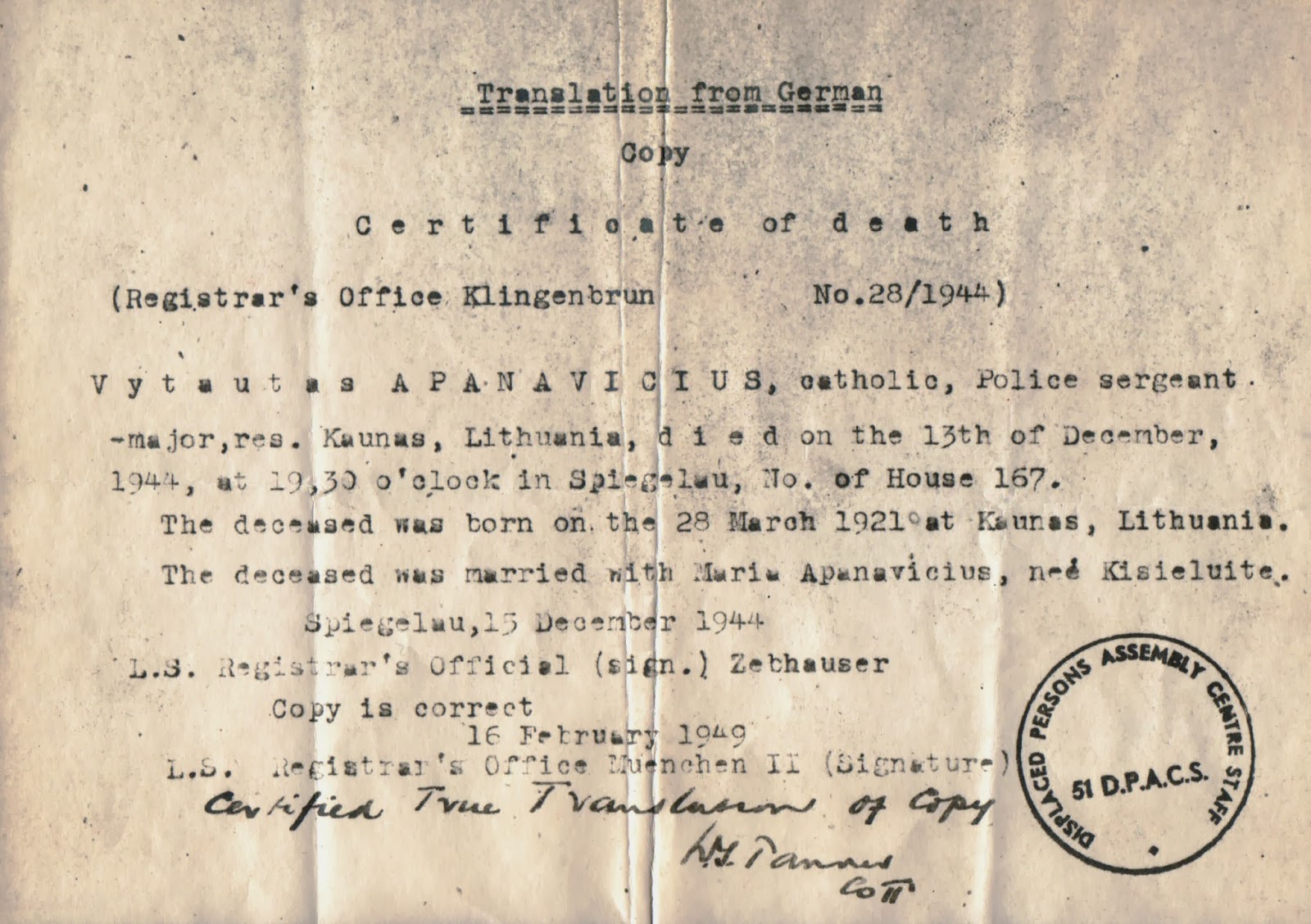
I'm attempting to piece together some of the story of my grandmother's time in Germany after The War, including the death of her first husband, Vytautas Apanavičius. According to the documents I received from the ITS in Germany, Vytautas was treated in a hospital in Bamberg and died in Klingenbrunn / Spiegelau. Another document shows that he died specifically in house number 167 of Spiegelau. From what I remember of močiute's story, she was not there when he died. By the time she got back, "he was already gone". One of the ITS documents shows that she was still in Bamberg. I don't know why. Two others with the Apanavičius name are listed in Bamberg as well, but the dates do not overlap, so I don't know why she was there longer. Nor do I actually know if the other two (Evaristas and Birute) are connected.

Treatment in Bamberg
(doc from ITS)

Death certificate, 13 Dec 1944
(original in German; docs from močiute)

Močiute remains in Bamberg until 5 Jan 1945

Grave registration from ITS


Contact with Apanavičius Family

Now that I'm (reluctantly) back in the United States and living in Philadelphia, I decided to reach out to the family of my grandmother's deceased first husband, Vytautas Apanavičius. As I explained previously, Vytautas died shortly after the family fled the Soviets after WWII. Eventually everybody settled in the United States and, despite re-marrying (to my grandfather, Vacys Matulis), they kept contact with the Apanavičius family, who settled in Ohio. I was never aware of any of this when I was younger - perhaps they didn't think we'd understand - but they used to visit each other. A couple years ago I jotted down an address for Raimundas Apanavičius from močiute's address book. Raimundas is Vytautas's youngest brother. I sent a letter earlier in the week explaining who I was and was contacted by his daughter, Rima, on Facebook.

It was very nice to make contact. Rima, inspired by this blog, is actually planning to start one herself. I'm really looking forward to hearing some of her stories! Hopefully it will even fill in some of the gaps in my story of močiute's life. Facebook conversations have already helped me to identify the people in one of her pictures. Jurgis also apparently had three brothers (Jonas, Juozas, and Zigmas) and a sister. They possibly remained in Lithuania. Birute is actually a cousin, not a child, of this family group.

Apanavičius Family

Despite only being married to Vytautas for about a year before he died, my grandmother kept his memory close for her entire life (some 70 years beyond his death!). She carried his photo with her until the day she died, and spoke fondly of him once I began asking questions. I have some of that recorded. For now, here is a clip of her telling the (somewhat spooky) story of their wedding day and how some expected he wasn't going to live a long life.


From the wedding ceremony.

10 January 2015

Serfdom

An interesting piece of information that I gleaned from the Exeter, NH Historical Society website is that it is unlikely that many (any?) ordinary Lithuanians emigrated before 1861. The reason is that common people were enserfed under the Russian Imperial system, and were not permitted to move from their local area (except for military service). Women moved to join their husbands' families when they married, but men were bound to their landlords. This means that I can be pretty sure of my family's origins going back quite far, if I can document them back to 1861.

06 January 2015

About Konstantas

Last August when visiting Adolis Matulis, one of my grandfather's brothers in Lithuania, I asked what he could tell me about his mother's father, Konstantas Kemešys. He couldn't tell me much, but I took some brief notes that I'm only just now getting around to posting. Jesse filmed the conversation, but it was entirely in Lithuania and translated through Elena.

He told us the same that I had heard previously from Phyllis, Konstantas was married three times. The first two wives died young. In fact, I believe the photo below, which is from Phyllis, is the funeral of his second wife, Antonina (Phyllis's grandmother's mother, my great-grandmother's step-mother or mother). The inscription on the back is apparently from Konstantas to his daughter Petronele (Phyllis's grandmother), who was already living in the US at the time (read translation here). In a second photo he is pictured with another (much younger) woman, and the inscription reads something along the lines of: please accept that [person's name] has come here with her family to stay and be a friend.

I believe Konstantas is to the right of the casket.

Reverse of photo above. Sylvester is Phyllis's uncle, Sylvester Žukauskas.

Konstantas with third wife?

Reverse of photo above.

Adolis also told us that Konstantas had about 12 children with his three wives: 3 with the first, 4 or 5 with the second, and 4 with the last. I believe Ona (my great-grandmother) was from the first wife and Petronele (Phyllis's grandmother) was from the second.

The last piece of information that I wrote down was that a son of the first wife died in a mine in the United States. Adolis didn't know where or what had happened (but I wonder if it was in the coal mines of Pennsylvania, where many Lithuanian emigrants settled). All he knew was that the family in Lithuania received compensation payments after the accident.

Here we are visiting with Adolis and his wife Kristina in Pakiršinys:

August 2014

20 December 2014

Tapestry Update

As I mentioned, I was very disappointed to learn last June that the Scottish Diaspora Tapestry did not include the panel to which I contributed parts of my family story. Several months later, though, I learned that it was only delayed, not abandoned, and work was continuing! I was really pleased to get that news. Today I met with one of the other contributors who is doing much of the actual stitching so that I could stitch in my family names, Kisielius and Raulinaitis, myself. I only had a short time, so I didn't actually get to finish (and some of my work was a bit dodgy so might need repaired), but at least I got to put a hand in. I'm looking forward to seeing it complete.

The latest design sketch.

My great-grandfather's side.

My great-grandmother's side.

As far as I got.

14 December 2014

A Connection?

I also found several further entries in the Glasgow poor books connected to the Kisielius name, including this one: Mariona Zatareckaite / Kisieliene. I'm, as yet, uncertain if she is connected to the family, but there a some things that make me think it is possible. First, she lived at 54 Rose Street. Second, her mother's name was Marianna Adomaityte, which could mean that she was related to Konstantinas Adomaitis (the first husband of Marijona Kisieliute).

Her 1917 application for poor relief states that her husband, Antanas Kisielius "died about 11 years ago in Russia". She had married him "about 15 years ago in Russia". In the residences section it says "about 6 years from Russia", which I take to mean that she arrived in Scotland in 1911. Does she turn up on the census? Who is she with?

There was no Antanas Kisielius listed in the immediate family group on this 1938 death certificate. So that could mean he was more distantly related. Or that he wasn't listed because he was already deceased. Or it's also quite possible there's no connection at all!!