01 January 2014

Vytis Pin

Over the holidays, I was showing my mom the photos from my trip to Lithuania last September, and I was telling her the back story to photo of me wearing Soviet and Lithuanian police uniforms. I also explained how I ended up with a little piece of Lithuanian independence memorabilia, and she said I ought to write the story down so that someday, long from now, whoever finds it would understand its significance. The uniforms belonged to my grandfather's niece's husband, Polivas Ladukas.

With Ada Matulyte/Ladukiene and Povilas Ladukas

After we met Povilas and Ada in Pasvalys, they wanted us to come back to Panevezys to show us where they lived. They didn't speak a word of English, but Elena and Vygintas were there to help us. Povilas rightly guessed I would be very interested to see his police uniforms from his time in the Soviet and, later, the newly independent Lithuanian police forces. First he brought out the Soviet hat and noticed that I was looking closely at, and commenting on, the hammer and sickle emblem. It was incredible to me to be holding such a thing, given the historic tensions between the Soviet Union and the United States.

Hammer and Sickle

Medals

Seeing how excited I was about it, he brought out his Lithuanian uniform. This one, of course, had none of the Soviet insignia on it. On the hat, in place of the hammer and sickle, was the emblem of Vytautas the Great, an important Duke of medieval Lithuania.

Vytis

For me, the symbolism was very strong. That emblem represented the freedom of Lithuanians from the oppressive and authoritarian Soviet government. I enthusiastically pointed this out, and then put the hat on my head, puffed up my chest, and strutted around for my cousins' entertainment. I wanted to express, without language, that I understood the significance of it all.

Proudly Lithuanian

My enthusiasm must have made an impression on Povilas because, as we were leaving, he pulled the Vytis emblem off of one of his uniforms and handed it to me to keep. This really meant a lot to me. I wouldn't have ever asked for such a thing, and I was actually somewhat reluctant to see it separated from the rest of the uniform, but I certainly am glad to have it.


Photos from Mom

While I was home for the holidays, I also scanned some photos from my mom's old albums. I won't write much about them now, but I'll include them below.

My mom's mom, Marzia (or "Marteece") O'Neil
Leitner, who I always called Nama.

My mom's dad, Alfred Leitner, who I always called Dampa.

Nama

Mom

Dampa acting goofy.

Dampa's mother, Lona Machlup Leitner

Tevuk pushing my sister Lacy and cousin Jesse around in a wheel barrow.

A "typical country scene" featuring Tevuk's barn in the local newspaper.

East Schodack NY, the village
where I was born.

Tevuk's garden at the farm.

Nama giving Dampa a haircut.

Nama and Mikey the Cat

Dampa with Taffy the Dog

Nama and Dampa in Provincetown, Cape Cod

Apanavicius

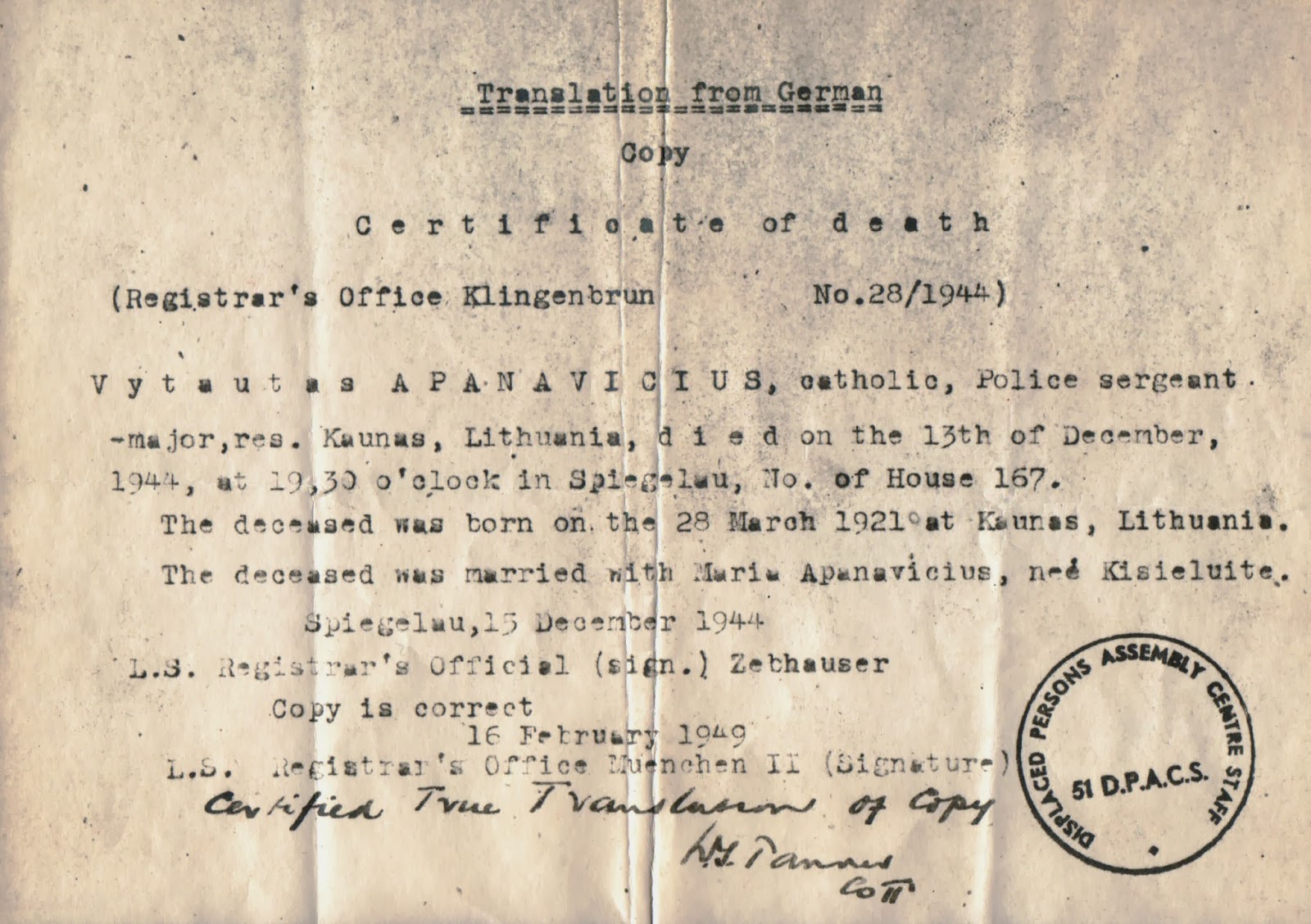
As I've mentioned a few times, Chute was married before she ever met Tevuk. He died, however, in Germany after they fled the second Soviet invasion of Lithuania. From the story that Chute has told me, her husband, Vytautas or "Vyto", died of what I believe was a stroke.

Vytautas Apanavicius

Death Certificate 1944
(original in German)

I never knew about Vyto until after Tevuk passed away. Indeed, Uncle Mike told me he never really knew much about him until after Tevuk died. Chute only ever really started telling her stories after Tevuk wasn't around to fill the conversation with his. Her first marriage couldn't have been too much of a secret, though, because Chute and Tevuk apparently used to go visit the Apanavicius family together in Ohio. Maybe she just felt that talking about being married before Tevuk would have been upsetting to her kids and us when we were young.

These days, however, she talks about Vyto with great affection. I think that's probably because she imagines her life would have been much easier if he had survived. Tevuk, as much as I have always revered him, expected a very traditional household and didn't allow Chute much freedom.

Wedding Ceremony

Chute's story (which I've got a recording of somewhere) was that at the wedding ceremony they each had a candle, and before the priest finished delivering their vows, Vyto's blew out. Several people, she said, interpreted that as an omen that his life was going to end early. Unfortunately, it proved true.

Dinner Party

Wedding Reception, complete with šakotis!

No idea who most of these people are, Kisielius and Apanavicius? Couldn't
say who the two scratched out are either.

This is the Apanavicius family, and Chute identified the people for me, but she said that it was her standing in the middle in the back and I can't be sure it really is. It doesn't look like her to me. Her hair is too dark, but I suppose it could just be a shadow. I recorded her memory of who each of them is here previously. Now that I think of it, maybe she didn't actually mean it was her in the middle in the back, but rather a different person called Maryte. I think I have a recording of her identifying them, I'll need to go back and have a look.

Apanavicius Family

Vyto was also apparently in the Lithuanian military. Chute told me the photo below is him in his uniform. I'm not sure why he wouldn't have been abducted by the Soviets along with her brother though. Chute still carries this in her purse today, nearly 70 years after his death.

Vyto in Uniform

The family is apparently still in Ohio, according to what I saw in Chute's address book. Someday I'll need to look them up.

More Photos and Documents

While I was in New York, I also took some time to scan some old photos and make copies of some documents. I'll just post some of them below.

I'd been looking for this one for ages, but couldn't remember where it was that I'd seen it. It is us as kids with Chute's mother, probably from 1983.

Jesse, Nick, Sofija, me, Lacy

This is a photo of Chute's brother, Kazimiras (on far left), after they'd won a soccer championship in Latvia. Chute believes it was the Lithuanian army soccer team, and she explained that they won a trophy, or "trowpy" as she calls it. It was probably in the late 1930s, in the days before basketball really took hold as the national sport.

Kazimiras Kisielius Jr (left)

This is a note from Kazimiras after he was abducted by the Soviets in the early 1940s. It was written on the back of this photo. Chute has translated some of it for me before, but I know it wasn't that precise. As I understand it, it is the last that was ever heard from him. I'm going to need to get Raimundas or Elena to translate it fully for me.

From Kazimiras

When I showed my photos from Vilkaviškis to Chute, I tried to show her ones of things she might recognize. The cathedral was damaged in the War and repaired after independence, so I wasn't sure she'd recognize it. She didn't really, but she pulled out this photo of her in front of it when she was in her 20s. It looks so different, I can't really even be sure it's the same building. She's on the right, and the one in the middle might be her sister Kitty, but I'm not sure who the person on the left is.

Cathedral in Vilkaviškis

This is the Kisielius family, probably in the 1930s. Standing in the back are Kazimiras Jr and Chute. Seated in the front are Sofija/Zose and Kazimiras Sr. On the right is Kitty/Katherine. And on the left is Elle (or Ily?) who, according to Chute, was a cousin.

Kisielius Family

This is from the early 1950s, shortly after they arrived in the US. My dad (in middle) was the first born in the US. My uncle "Mike" (actually Mečys) is on the left, and my uncle "Charlie" (actually Gediminas) is on the right. Charlie was born in Germany in the camps.

Chute and her "three stooges", as she sometimes calls them.

This is later (1960s already?) after they had gotten the farm in East Schodack. I'm not old enough to remember when they had cows, but they were still raising hay when I was a kid.

Chute milking the cows.

I also went through Chute's address book and asked her about all the people listed in the hope that it would spark some memories and possibly give me some more leads. I recorded the conversation, but we didn't get all the way through both books. I took photos of all the pages though. Here is the entry that started my whole genealogy pursuit. The address is almost certainly long outdated.

Mrs "Helen Tracy Louis" or, as I know now,
Helen Valaitis and her husband Louis Tracy

Mike also pulled out some old documents. This is Chute's certificate of naturalization.

Chute's Naturalization

This is an "extract of the marriage record" for Chute and Tevuk, apparently produced in the Wolterdingen displaced persons camp in 1948. It shows that they were married in St. Ludwig's in Munich on 2 September 1945. Note that it shows both her maiden name, Kisieliute, and her first married name, Apanaviciene.

Marriage 1945

I'm not sure yet what this is. I'm going to need to get a German friend to help me understand it. It appears to be a church document regarding Chute's marriage to Tevuk. It shows their marriage date, but it was created in February 1946, 5 and half months after they were married.

Munich 1946

This is another record from the camps. It appears to certify Chute's christening from 1921, and it shows her birthday (15 January). It must have been made from her original copy, but I'm not sure why she doesn't have that. The official copy, I know from going to the archive in Lithuania, has been lost. That makes this really important.

Christening 1921

Visit to NY

On my visit back home to New York, I had planned to continue gathering information from Chute about the family and her experiences fleeing from Lithuania at the tail-end of WWII. Unfortunately, this is getting considerably more difficult as her hearing, memory, and English are declining. She's still doing quite well for somebody who is nearly 93, but it's a challenge to get much detail from her. I had hoped to make a recording of her experiences in the displaced persons camps after the war for a project at the Balzekas Museum, but I didn't get much more than a few disjointed stories (something about a pig on the second floor of a house!).

At times, though, she had real clarity. As I mentioned previously, I also planned to help her make a request to the Lietuvos Ypatingasis Archyvas for information about her brother. They have researchers that can search archives for information about Lithuanians that were deported and/or killed under Soviet rule. They just need requests in writing and documents proving family relation. I was a little bit worried that it would all be too complicated to explain what we needed for her to write, but I was pleasantly surprised that she had almost no difficulty at all. I explained that she needed to write a letter requesting the information and, without missing a beat, she picked up a pen and started to write. My uncle Mike was there to help and to confirm she was writing something that made sense. I think we weren't giving her enough credit because she wrote more detail than she probably even needed to.

Written by Chute

In addition to the request, we needed to provide documents showing that we are connected to her brother - they won't release personal information otherwise. Fortunately, Mike was able to dig up Chute's marriage certificate showing her maiden name. I had never seen it before, and it was key for proving the connection. I've sent all of these things over to the archive and, hopefully, we'll hear something back soon.

Marriage Certificate

Also significant on this document is the name of the camp they were in, in Germany. I had asked Chute about this several times previously, but she was never able to recall the name. It was called Wolterdingen. All I had been able to get from her before was that her first husband, Vytautas Apanavicius, had died near Munich, so I knew she had been there, at least briefly. There appears to be (at least) two different Wolterdingens, however - one in the Black Forest region and one near Soltau - neither of which is that close to Munich. I couldn't be sure where they were for most of the approximately 3 years that they remained in Germany. But now I at least have somewhere to start.

Wolterdingen, Germany

One of the Wolterdingens, though, is not far from the infamous Bergen-Belsen camp where Anne Frank died. Which is where Ronnie told me Kazimiras and Sofija/Zose (Chute's parents) had been. I suspected previously that Chute was traveling with her first husband's family, but perhaps she was relocated to the camp her parents were in after he died. Or maybe they were all transferred. There must be records of this somewhere. Perhaps somebody at the Balzekas museum will be able to help.

I also showed Chute one of the photos from Ronnie to see if she might recognize her father among the miners. She didn't. But that's not to say it's definitely not him. The image I had was grainy. I'll need to get a clearer copy and then maybe try to compare it to some of the photos I do have of him.

I showed Chute some of the photos I took in Lithuania too. I had hoped she'd recognize some of the landmarks and it would stir up fond memories. One of the things she identified was the Šeimena river that runs through Vilkaviškis which, she said, "was full of leeches". Not exactly the reaction I was going for.

Šeimena River

The leeches, however, were better than the other memory that one of my photos elicited. I showed her the Kaunas funicular rail car, which Arunas told me was about 90 years old. She didn't recognize it right away, but once I explained what it was she remembered. Then she told me that was where the Soviets held public hangings of political dissidents. Again, not the intended effect.

Kaunas Funicular

Apart from these unintentional forays, it was just really nice to see Chute. She's quite a character these days. For example, on occasion in the past, when switching between languages, she'd accidentally say something to me in Lithuanian. She usually found this quite funny and then repeated it in English. This time, however, when Mike pointed out that I couldn't understand anything she was saying, she simply shrugged her shoulders and said back to him "he'll learn". She seems to have developed a feisty sense of humor. She also loves recalling funny stories, like the time I got sick from eating too many tomatoes from their garden. I've heard that story about 100 times, but she laughs like it was the first every time, and I enjoy that. It's just nice to get the chance to be there with her.


08 December 2013

Kisielius Photos

I received a letter from Ronnie the other day with copies of some really great photos! Of them, this one really caught my attention.

Scottish Miners

One of them could quite possibly be my great-grandfather Kazimiras. I'm not certain how old the photo is, or if it is old enough to be from when Kazimiras was still in Scotland (pre-1917), but Ronnie didn't think it was her grandfather Jonas because he was a steelworker, not a miner. I see a resemblance to the guy all the way to the left, but it might just be wishful thinking. I will need to ask Chute when I'm back there next week. Hopefully she will be able to identify him. He was her father so she would know his face, of course, but her vision isn't the best, so I'm not certain she'll be able to see the detail.

Some of the other photos are very interesting too:

Jonas and Magde
(Ronnie's grandparents, Kazimiras' aunt and uncle)

This is the "Mrs Valaitis" that Chute has spoken of
before, with Ronnie's mother Ona.

The other thing Ronnie sent was a photocopy of her grandfather Jonas's Russian army passbook. It has some English translations, but I will need to get some help translating the rest. It is from a time before WWI, not from when the Lithuanians in Scotland were deported under the Anglo-Russian Military Convention. Jonas would have been old enough to be exempt by then.

Jonas's name in Russian was apparently "Ivan Peter Kisiel"
He enlisted in 1889 and served until 1904.

This page shows that he had checked in at the Imperial Russian Consulate
in Glasgow in June 1916. I wonder if this is a sign of the preparations being
made for the Anglo-Russian Military Convention that went into force the
next year.

I found the passbook particularly interesting because, had my great-grandfather had such documentation when he was deported, it would have been his ticket back to Scotland after the War.* After the Lithuanian immigrants were sent from Scotland to Russia, they weren't allowed to come back if they couldn't "prove loyalty". Some had been involved with the Red Army at the start of the Bolshevik Revolution. If they couldn't produce a White Army passbook, they were suspect.

Digital copies of the photos and passbook are here:


* I should note that I don't yet have confirmation that Kazimiras was, in fact, deported under the 1917 Convention. But I am confident that he was.